Every student at Logos University®
has the skills to do something extraordinary!
A degree from Logos University® allows you to acquire more than a degree – it transforms the way you see the world and your place in it, it gives you the right to belong. Based on ethics and social justice, your education enables you to find solutions to global problems and effect change in your own community.
You will have the opportunity to produce autonomously, to create an intellectual environment that brings out your most important latent capacities. There is no education without freedom of thought.
At Logos University® you will work side by side with researchers, publish and be the protagonist of your own success.
We offer research-based course programs aimed at adults determined to gain a voice, to make their own way by exercising their own freedom, making their careers based on educational intelligence.
You will have the opportunity to internationalize your curriculum through double degree programs.
University Catalog
 Today I decided to write to you about International education. From corner to corner we visualize several passive educational systems, where the first step of the education process is based on listening and the second on following.
Our education needs to change, instead of criticizing the new educational models, we need to investigate why in certain communities they work much better than our educational model, the convenient model that puts us in a comfortable situation.
Educating is a mission, teaching is a divine gift achieved by few people focused on building, building a more conscious and just society.
The world is in a constant conflict about the best method to advance scientifically, there is a constant duel between faith and science. But what is actually done without faith? Without believing in the conquest or without seeking the motivation to have a good and new idea.
Education involves great internal changes, it involves the stoning of a rough personality into a polished human being. All this is beyond a certificate, it is in a noble mission to change, to improve voluntarily in the depths of each one, in the union of concepts of faith and science.
The Union of educational institutions creates a wide space for debates, the impact of which is usually overwhelming and can even change the vision and mission of an educational Academy, which is why one cannot think of a single way of teaching, since there is no there is only one way to learn. This is part of every human being’s self-feedback.
UniLogos chose its phrase, a hallmark marked in the heart of the institution: “suae quisque fortuna faber”.
Yes… “Man is the architect of his own destiny”, Frank Miller’s phrase brings us to our true reward, our harvest, fruit of our choices. Being an architect of your own destiny means being intimately connected with your mission in life, with your true will, which is why each step has a special flavor.
Our biggest dream is to build new dreams and to create the possibility of expanding self-pride in the heart of those who achieve their ideal, their way of life, their dream and their success.
As Rector of this noble Institution, I have the mission to be firm without losing my tenderness, I have the mission to lead the process of raising the consciousness of those who come in search of a light, the light of education.
Welcome!
Prof. Dr. Gabriel Lopes Ph.D, DBM, Psy.D
University President
The mission of LOGOS UNIVERSITY INTERNATIONAL (UNILOGOS) is to provide a high-quality education to a culturally diverse student body in order to prepare them to enter the global workforce, pursue higher education opportunities and serve in their communities.
The university also seeks to expand knowledge through relevant research and publications. UniLogos® has publications in renowned International Journals indexed by Web of Science, Scopus and with quality assessment by the Qualis Capes system of the Brazilian Ministry of Education, a country in which it has one of the highest recognition rates of diplomas by the Federal Government platform and it is registered in the Division of Foreign Institutions of the MEC with the number L489.
In support of this mission, we are committed to:
Promote student development, encouraging and sustaining a productive institutional culture of assessment that leads to continuous improvement of academic and administrative programs;
Develop an organizational culture that values and encourages intellectual curiosity, a sense of belonging and shared purpose among faculty, students and staff, and the pursuit of excellence in all endeavors;
Recruit and develop outstanding faculty to become leaders in their respective fields and internationally recognized academics;
Achieve recognition as an effective, innovative, technology- and development-focused educational and research institution;
Recruit and retain an excellent, highly select and culturally diverse student body;
Broaden the debate on social and professional problems through consolidated studies proposing real and viable solutions;
Provide personal and professional growth opportunities for traditional and non-traditional students and faculty and staff members;
Secure and maintain professional accreditation for all appropriate programs, directly or indirectly through strategic partnerships.
In the UNILOGOS® university calendar, the academic year is divided into semesters, with periods of activities, exams and vacations. Here is an example of a typical university calendar, divided into two semesters:
Semester I:
Student enrollment and registration: January (or recurring depending on the course)
Academic activities: February to June
Exam period: June to July (or scheduled depending on the course)
Summer vacation: July and August
Semester II:
Enrollment and registration of students: August
Academic activities: September to December
Period of exams: scheduled through the course coordinators
Winter holidays: December to February
It is important to emphasize that we have a calendar of continuous activities due to the 100% online teaching. Students should be guided through the study plan available by the coordination. In the virtual environment, we offer instructions for the Study, Reflection and Production process (UniLogos Knowledge Curation Methodology).
Our university calendar includes national and local holidays, as well as academic recess periods such as Christmas, Easter or other specific dates. Pay attention to these dates, since the General Secretariat and the General Mediation Center are not available.
TERMS AND CONDITIONS OF USE
Logos University International – UniLogos
1. Acceptance of Terms
By accessing or using this website and the services of Logos University International – UniLogos (“UniLogos”, “we”, “our” or “the University”), you agree to comply with these terms and conditions of use, as well as our Privacy Policy, which together govern your relationship with us in relation to this website. The term “you” refers to the user or visitor of the site.
If you do not agree with any part of these terms, please do not use or access the website or any related services.
UniLogos grants you a personal, non-transferable and non-exclusive right to access and use the materials, content and software made available, provided that they are not copied, modified, distributed or used improperly.
By registering, you declare that you are of legal age to enter into a binding contract and that the data provided is true, complete and up-to-date.
2. Privacy Policy
Your privacy is important to us. By using the website, you agree to the collection, use, and protection of your personal data as described in our Privacy Policy, which forms an integral part of these Terms.
3. User Account, Password, and Security
To access certain services or content, you may need to create a user account. You are responsible for maintaining the confidentiality of your login credentials and for all activities performed under your account.
You agree to:
• Immediately notify UniLogos of any unauthorized use or security breach;
• Log out after each use.
UniLogos is not liable for any loss or damage resulting from your failure to protect your credentials.
4. Intellectual Property Rights
All content presented on this website — including text, images, graphics, videos, software, and other materials — is protected by intellectual property laws and is the property of UniLogos or its licensors. Reproduction, distribution, modification, or publication without prior written authorization is prohibited.
5. User Conduct
You agree not to use the site to:
• Send or transmit defamatory, obscene, illegal, or offensive material;
• Infringe the rights of third parties;
• Spread viruses, malware, or harmful software;
• Violate any applicable laws or regulations.
UniLogos reserves the right to remove content that violates these terms and to take legal action when necessary.
6. Internet Connection
Access to content requires an active internet connection, and data costs are the user’s responsibility. UniLogos does not guarantee continuous and uninterrupted access, and interruptions may occur for maintenance or due to external factors.
7. Refund Policy
Payments made for products or services provided via the UniLogos platform will not be refundable after delivery or availability to the student, except when the product or service does not correspond to the description. Interruption of payment may result in account suspension or termination.
8. Payment of Fees
Tuition fees, course fees, and any other amounts due must be paid in full according to the agreed-upon conditions. Failure to pay within the established deadlines may result in the suspension of academic services, blocked access to platforms, and eventual termination of the contractual relationship.
9. Discount Codes
Promotional codes and scholarships are valid only for qualifying purchases and are subject to the conditions under which they were issued.
10. External Links
This website may contain links to third-party websites. UniLogos does not control and is not responsible for the content, policies, or availability of these external websites. Any access to or use of linked websites is the sole responsibility of the user.
11. Content and Price Changes
We reserve the right to change content, service descriptions, and prices without prior notice. Such changes will not impact services or products already delivered.
12. Academic Integrity
Students are expected to maintain high standards of academic integrity. Plagiarism, fraud, collusion, and other forms of misconduct will be dealt with according to internal regulations and may result in disciplinary sanctions.
13. Jurisdiction and Applicable Law
These Terms are governed by the laws applicable to the location where UniLogos operates. Any dispute arising from these terms will be resolved under the competent jurisdiction established by applicable legal norms.
14. Secure Payments
Payments made through UniLogos platforms are processed by secure services that comply with international data protection standards, in accordance with current regulations.
PUBLIC INFORMATION – LEGALITY AND TRANSPARENCY
- Course Accreditation and Institutional Authorization
Institutional Authorization
Logos University International (UniLogos) operates under French Education Law (Education Code, Articles L.444-1 to L.444-11 and R.444-1 to R.444-28), which governs private higher education institutions in France.
Within the French higher education system, institutions are classified as follows:
- “Sous contrat” institutions: Receive state funding, follow the national curriculum, and employ teachers paid by the government.
- “Hors contrat” institutions: Operate independently, do not receive government funding, and are not required to follow the French national curriculum.
Logos University International (UniLogos) is a “hors contrat” institution, which means:
- Its programs and diplomas are institutional (private) qualifications and are not equivalent to national diplomas issued by French public universities.
- All programs are offered exclusively in Portuguese, Spanish, and English.
- The institution seeks international accreditation and professional recognition outside France.
- Restrictions under French Legislation
French educational legislation prohibits private institutions from using the protected LMD terminology — “baccalauréat,” “licence,” “master,” or “doctorat” — for their diplomas.
Logos University International – UniLogos fully complies with this regulation and instead uses the terms “Bachelor,” “Master,” and “Doctor”, in a format authorized by the Académie de Paris.
All Logos University International programs are:
- Institutional diplomas, not national diplomas.
- Delivered exclusively in Portuguese, Spanish, and English.
- Offered entirely through distance learning (online education).
- Transparency in Diploma Recognition
French law requires private educational institutions to clearly distinguish their institutional diplomas from national diplomas in order to avoid misrepresentation.
To ensure full transparency:
- All diplomas issued by UniLogos are strictly “diplôme d’établissement” (institutional diplomas).
- These diplomas do not confer the same legal status as national diplomas issued by French public universities.
The designation “diplôme d’établissement” is clearly stated in:
- The contract between the student and UniLogos (each student has an individual contract with specific information);
- The application process;
- The admissions and selection process;
- The student’s academic transcript (training record).
- Constitutional Council Decision No. 77-87 DC of November 23, 1977
“Decision 77-87 DC – November 23, 1977 – Supplementary Law to Law No. 59-1557 of December 31, 1959, as amended by Law No. 71-400 of June 1, 1971, relating to freedom of education – Constitutionality”
Decision No. 77-87 DC (11/23/1977) represents a constitutional review conducted by the French Constitutional Council regarding a law supplementing the so-called Debré Law (Law No. 59-1557/1959), which regulates relations between the State and private educational institutions, particularly those under contract with the State.
In its Item 4, the decision states:
“Whereas the affirmation, by the same Preamble of the 1946 Constitution, that ‘the organization of free and secular public education at all levels is a duty of the State’ cannot exclude the existence of private education, nor the granting of state aid to such education under conditions defined by law; and whereas this provision of the Preamble of the 1946 Constitution therefore has no bearing on the constitutionality of the law submitted to the Constitutional Council for review.”
This excerpt establishes a constitutional interpretation of major relevance for private higher education institutions in France. By affirming that the State’s duty to organize free and secular public education cannot exclude the existence of private education, nor prevent state aid under legally defined conditions, the Constitutional Council sets a clear boundary on the State’s role in education.
This interpretation has a direct effect on the institutional freedom of duly authorized private universities. The Council explicitly rejects any interpretation suggesting that the State’s mission in public education implies exclusivity, monopoly, or absolute primacy over private education. On the contrary, private education is constitutionally recognized as a legitimate component of the French educational system, coexisting with public education within a pluralistic constitutional framework.
In this context, Logos University International – UniLogos, as a private university authorized by the Paris Rectorate, operates fully within the constitutionally protected space of freedom of education. This administrative authorization confirms not only the institution’s legal standing, but also its capacity to develop its own academic activities according to its institutional identity, pedagogical project, and educational mission.
The decision reinforces that the French Constitution does not condition the legitimacy of private education on replicating the public education model, nor on submission to uniform state pedagogical directives. Instead, the State’s role is limited to ensuring compliance with applicable laws, without interfering in the academic or organizational autonomy of duly authorized private institutions.
Accordingly, Logos University International holds legal freedom to design, structure, and operate its own academic programs, including higher education and postgraduate programs, provided that all applicable legal and regulatory standards are respected. Constitutional compliance requires legal conformity, not identity or methodological conformity.
By declaring that the 1946 Preamble does not negatively affect the constitutionality of the examined law, the Constitutional Council reaffirms that the French legal order protects educational pluralism and prevents the State’s duty toward public education from being used as a basis to restrict, obstruct, or distort the legitimate activities of private institutions.
Thus, in light of this decision, Logos University International, as a private university authorized by the competent French authority, conducts its academic activities under constitutional protection of the freedom of education, enjoying autonomy to operate its own programs in compliance with applicable law, without being subject to restrictive interpretations that would undermine the constitutional balance between public and private education in France.
Official decision link:
https://www.legifrance.gouv.fr/cons/id/CONSTEXT000017665684/
UNILOGOS IS LEGALLY AUTHORIZED TO OPERATE INDEPENDENTLY AND ISSUE PRIVATE DIPLOMAS/CERTIFICATIONS IN ACCORDANCE WITH
Articles L.444-1 to L.444-11 of the French Education Code, which govern private distance education, establish the legal framework under which UniLogos conducts private certification processes using its own methodology, known as Knowledge Curation, as well as RPL (Recognition of Prior Learning). These processes assess experiential, non-formal, and informal learning, provided they remain clearly distinct from the regulated VAE (Validation of Professional Experience) framework governed by Articles L.613-3 and L.613-4.
- Article L.731-1 of the French Education Code (which affirms the freedom of private higher education);
- Law of July 1, 1901 (granting legal personality to non-profit associations);
- Law of July 12, 1875 (affirming the freedom to establish private higher education institutions).
Issuance of Private Certifications
- Legal basis: Articles L.444-1 to L.444-11 of the French Education Code, governing private distance-learning institutions.
- RNCP registration: Optional and not mandatory.
Under Article L.6113-5 of the French Labor Code, RNCP registration is a voluntary process that validates a certification, not the institution itself. It is not a requirement for legal operation, and the absence of RNCP registration does not affect UniLogos’ legal status or its right to issue private diplomas.
In summary, UniLogos operates legally under French educational law and retains the right to issue private certifications — even without RNCP registration — provided it maintains transparency regarding its status and avoids protected academic titles.
Independent Operation Without RNCP Registration
- Legal basis: Law of July 12, 1875; Law of July 1, 1901; and Article L.731-1 of the Education Code.
Optional Application for RNCP Recognition
- Legal basis: Article L.6113-5 of the Labor Code and the RNCP Manual, Section 1.3.2.
Integration of Experiential Learning Methodologies (VAE)
- Legal basis: Articles L.613-3 and L.613-4 of the Education Code, supported by Decree No. 2002-590 and Articles R.613-32 to R.613-37.
LEGAL FOUNDATIONS SUPPORTING UNILOGOS’ RIGHTS
Law of July 12, 1875
Affirms the freedom to establish private higher education institutions without prior State authorization, provided they do not issue national diplomas.
Law of July 1, 1901
Grants legal personality to non-profit associations such as UniLogos, enabling independent educational activity.
Article L.731-1 of the Education Code
Establishes that “Private higher education is free”, provided that protected titles are not used and no claim of public recognition is made.
Articles L.444-1 to L.444-11 of the Education Code
Authorize private institutions to provide distance education and issue their own diplomas or certificates, even without state accreditation.
Articles L.613-3 and L.613-4 of the Education Code
Permit institutions to validate prior learning (VAE) and recognize experiential learning, supporting alternative certification pathways.
UNIFIED LEGAL BASIS FOR UNILOGOS’ INDEPENDENT OPERATION UNDER FRENCH LAW
Law of July 12, 1875 – Freedom of Higher Education
This foundational law establishes that higher education is free in France. It allows individuals and private associations to create higher education institutions without prior State authorization, provided they do not issue national diplomas. It constitutes the historical root of institutional independence.
Law of July 1, 1901 – Associations Law
Grants legal personality to non-profit associations such as UniLogos, allowing them to pursue educational missions without State supervision unless public recognition or funding is sought.
“Hors Contrat” Institutional Status
According to official Ministry of Education guidelines, institutions that do not contract with the State (hors contrat) are not subject to Rectorate supervision regarding curriculum, accreditation, or diploma validation. They are subject only to basic regulatory controls (e.g., public order, health, and safety).
Article L.731-1 of the Education Code
States that “L’enseignement supérieur privé est libre” — private higher education is free — provided protected titles are not used and no claim of public recognition is made.
Case Law and Administrative Practice
French courts and administrative bodies have consistently upheld the right of private institutions to operate outside the Rectorate system, provided they do not misrepresent their status or issue protected diplomas.
If you intend to use a qualification awarded by Logos University International (UniLogos) for purposes such as:
• Engineering licensure
• Counseling or psychology licensure
• Teacher certification
• Medical, legal, or other regulated profession licensure
• Immigration procedures, work permits, or civil service eligibility
Please read the following carefully:
Logos University International (UniLogos) does not guarantee recognition, equivalence, validation, or automatic acceptance of its diplomas in any country, jurisdiction, or professional regulatory system worldwide.
The recognition of academic qualifications and the granting of professional licensure are sovereign acts governed by the legislation, regulatory agencies, and professional councils of each country. In many cases, requirements vary not only by nation, but also by state, province, or professional board. These criteria are independent from the legal status, accreditation, or international recognition of the issuing higher education institution.
Professional authorization processes may include, but are not limited to:
• National or regional licensing examinations
• Academic recognition or diploma equivalency procedures
• Mandatory supervised professional practice hours
• Registration with professional councils or statutory boards
• Additional local coursework, certifications, or professional training
• Language proficiency requirements
• Immigration or labor authority approvals
Students and graduates are solely responsible for verifying, prior to enrollment and prior to using their qualification for professional purposes, the specific legal and regulatory requirements applicable in the country or jurisdiction where they intend to reside, work, or seek professional registration.
Ethical Commitment and Professional Responsibility
UniLogos affirms that all academic and professional advancement must be grounded in ethics, transparency, and competence. No higher education institution can legitimately promise automatic global recognition of diplomas, as such authority rests exclusively with sovereign regulatory bodies.
Accordingly, UniLogos encourages its students and graduates to act with integrity, to seek accurate information from competent authorities, and to prioritize the development of genuine professional competence as the foundation of their careers.
Institutional Quality and International Legitimacy
Logos University International (UniLogos) is a higher education institution dedicated to academic excellence and quality assurance at the tertiary level. In alignment with this commitment, the institution has sought and obtained legal and legitimate international credentialing consistent with applicable regulatory frameworks.
This international positioning reflects UniLogos’ dedication to structured governance, academic standards, and responsible institutional development. However, such credentialing does not override or replace national licensure requirements imposed by professional authorities in any jurisdiction.
Final Statement
UniLogos remains firmly committed to educational quality, institutional transparency, and responsible academic practice. While the University confers academically valid qualifications within its legal and institutional framework, compliance with professional regulatory systems and recognition procedures remains under the exclusive authority of the competent bodies in each country.
LEGAL REPORT ON THE USE OF ECTS CREDITS IN ACADEMIC TRANSCRIPTS
- INTRODUCTION
This report aims to demonstrate, based on normative and international grounds, that there is no legal prohibition on the use of ECTS credits in academic transcripts issued by private universities authorized in France. It also seeks to substantiate that the reference to ECTS may be linked to the institution’s international accreditation and not exclusively to French authorization. It is worth noting that although Logos University International (UniLogos) is based and authorized in French territory, its academic programs are characteristically “international”, offered to diverse communities and supported by legally valid and legitimate transnational accreditation. The use of the ECTS credit system is grounded in our alliances, joint programs, multiple accreditations, and international recognition frameworks, and not exclusively in the specific system of any single country.
- ECTS SYSTEM FRAMEWORK
The European Credit Transfer and Accumulation System (ECTS) is an instrument created within the Bologna Process to ensure transparency, comparability, and academic mobility within the European Higher Education Area (EHEA).
ECTS does not constitute a diploma or an academic degree, but rather a metric of student workload and learning outcomes.
- REGULATION IN FRANCE
French legislation does not establish any explicit prohibition regarding the use of ECTS by authorized private institutions. The use of ECTS is mandatory only for French national degrees (Licence, Master, and Doctorat). For international programs or programs not classified as national degrees, ECTS may be used as an informative and academic transparency tool, provided that there is no misleading indication of automatic recognition, which is not the case here.
- INTERNATIONAL ACCREDITATION AND THE LISBON CONVENTION
The institution holds legitimate international accreditations, including accreditation by an organization recognized by the Ministry of Education of the Kyrgyz Republic, a country that is a signatory to the Lisbon Recognition Convention, as evidenced by the following link:
https://www.coe.int/en/web/conventions/full-list?module=treaties-full-list-signature&CodePays=KIR
The Kyrgyz Republic acceded to the Lisbon Convention in 2004 and is listed under Treaty No. 165.
Link: https://www.coe.int/en/web/conventions/full-list?module=treaty-detail&treatynum=165
Informational link: https://en.wikipedia.org/wiki/Lisbon_Recognition_Convention
The Lisbon Convention on the Recognition of Higher Education Qualifications is the only international legal treaty within the European Higher Education Area (EHEA).
This convention establishes that qualifications obtained in signatory countries must be assessed fairly and transparently by other signatory countries, reinforcing the legitimacy of using internationally compatible credit systems such as ECTS.
- NATURE OF THE FRENCH DEGREES ISSUED BY LOGOS UNIVERSITY
See: “PUBLIC INFORMATION – LEGALITY AND TRANSPARENCY”
Link: https://logosedu.eu/academics/#catalog
- ABSENCE OF LEGAL PROHIBITION ON THE USE OF ECTS
There is no French, European, or international law that prohibits the use of ECTS in academic transcripts issued by authorized private institutions. ECTS is recognized as an internationally referenced technical tool and may be used by institutions outside the French public system, provided its purpose is clearly informative.
- LINK BETWEEN ECTS AND INTERNATIONAL ACCREDITATION
The reference to ECTS in the academic transcript of Logos University International (UniLogos) is related to its curricular structure aligned with international standards of workload and learning outcomes, as well as to the international accreditations obtained. It does not constitute a declaration of automatic equivalence with French national degrees.
- CONCLUSION
- There is no legal prohibition on the use of ECTS by private universities authorized in France;
• ECTS may be legitimately used as an academic transparency tool;
• Logos University operates with approximately 80 alliance and recognition agreements with universities worldwide, particularly with higher education institutions within the EHEA;
• The reference to ECTS may be grounded in the institution’s international accreditation and the Lisbon Convention;
• The use of ECTS does not imply automatic recognition by French authorities, and this distinction is legally valid.
VERSION FRANÇAISE
RAPPORT JURIDIQUE SUR L’UTILISATION DES CRÉDITS ECTS DANS LES RELEVÉS DE NOTES ACADÉMIQUES
- INTRODUCTION
Le présent rapport a pour objectif de démontrer, sur des bases normatives et internationales, qu’il n’existe aucune interdiction légale quant à l’utilisation des crédits ECTS dans les relevés de notes académiques émis par des universités privées autorisées en France. Il vise également à établir que la mention de l’ECTS peut être liée à l’accréditation internationale de l’institution et non exclusivement à l’autorisation française. Il convient de souligner que, bien que Logos University International (UniLogos) soit établie et autorisée sur le territoire français, ses programmes académiques sont de nature essentiellement « internationale », proposés à diverses communautés et fondés sur une accréditation transnationale légale et légitime. L’utilisation du système de crédits ECTS repose sur nos alliances, nos programmes conjoints, nos accréditations multiples et nos cadres de reconnaissance internationale, et non exclusivement sur le système spécifique d’un pays déterminé.
- FONDEMENT DU SYSTÈME ECTS
Le Système européen de transfert et d’accumulation de crédits (ECTS) est un instrument créé dans le cadre du Processus de Bologne afin de garantir la transparence, la comparabilité et la mobilité académique au sein de l’Espace européen de l’enseignement supérieur (EEES).
L’ECTS ne constitue ni un diplôme ni un titre académique, mais une mesure de la charge de travail de l’étudiant et des résultats d’apprentissage.
- RÉGLEMENTATION EN FRANCE
La législation française n’établit aucune interdiction expresse concernant l’utilisation de l’ECTS par des établissements privés autorisés. L’utilisation de l’ECTS est obligatoire uniquement pour les diplômes nationaux français (Licence, Master et Doctorat). Pour les programmes internationaux ou les programmes ne relevant pas des diplômes nationaux, l’ECTS peut être utilisé comme un outil informatif et de transparence académique, à condition qu’il n’y ait aucune inductions en erreur quant à une reconnaissance automatique, ce qui n’est pas le cas.
- ACCRÉDITATION INTERNATIONALE ET CONVENTION DE LISBONNE
L’institution dispose d’accréditations internationales légitimes, notamment d’une accréditation délivrée par un organisme reconnu par le ministère de l’Éducation de la République kirghize, pays signataire de la Convention de Lisbonne sur la reconnaissance des qualifications, comme indiqué par le lien suivant :
https://www.coe.int/en/web/conventions/full-list?module=treaties-full-list-signature&CodePays=KIR
La République kirghize a adhéré à la Convention de Lisbonne en 2004 et est inscrite sous le Traité n° 165.
Lien : https://www.coe.int/en/web/conventions/full-list?module=treaty-detail&treatynum=165
Lien informatif : https://en.wikipedia.org/wiki/Lisbon_Recognition_Convention
La Convention de Lisbonne sur la reconnaissance des qualifications relatives à l’enseignement supérieur est le seul traité juridique international de l’Espace européen de l’enseignement supérieur (EEES).
Cette convention prévoit que les qualifications obtenues dans les pays signataires doivent être évaluées de manière équitable et transparente par les autres pays signataires, renforçant ainsi la légitimité de l’utilisation de systèmes de crédits compatibles à l’échelle internationale, tels que l’ECTS.
- NATURE DES DIPLÔMES FRANÇAIS DE LOGOS UNIVERSITY
Voir : « PUBLIC INFORMATION – LEGALITY AND TRANSPARENCY »
Lien : https://logosedu.eu/academics/#catalog
- ABSENCE D’INTERDICTION LÉGALE DE L’UTILISATION DE L’ECTS
Il n’existe aucune loi française, européenne ou internationale interdisant l’utilisation de l’ECTS dans les relevés de notes académiques des établissements privés autorisés. L’ECTS est reconnu comme un outil technique de référence internationale et peut être utilisé par des institutions situées en dehors du système public français, à condition que son usage soit clairement informatif.
- LIEN ENTRE L’ECTS ET L’ACCRÉDITATION INTERNATIONALE
La mention de l’ECTS dans le relevé de notes académique de Logos University International (UniLogos) est liée à sa structure curriculaire alignée sur les normes internationales de charge de travail et de résultats d’apprentissage, ainsi qu’aux accréditations internationales obtenues. Elle ne constitue pas une déclaration d’équivalence automatique avec les diplômes nationaux français.
- CONCLUSION
- Il n’existe aucune interdiction légale à l’utilisation de l’ECTS par des universités privées autorisées en France ;
• L’ECTS peut être légitimement utilisé comme un outil de transparence académique ;
• Logos University opère avec environ 80 accords d’alliance et de reconnaissance avec des universités du monde entier, notamment avec des établissements d’enseignement supérieur de l’EEES ;
• La mention de l’ECTS peut être fondée sur l’accréditation internationale de l’institution et sur la Convention de Lisbonne ;
• L’utilisation de l’ECTS n’implique pas une reconnaissance automatique par les autorités françaises, cette distinction étant juridiquement valable.
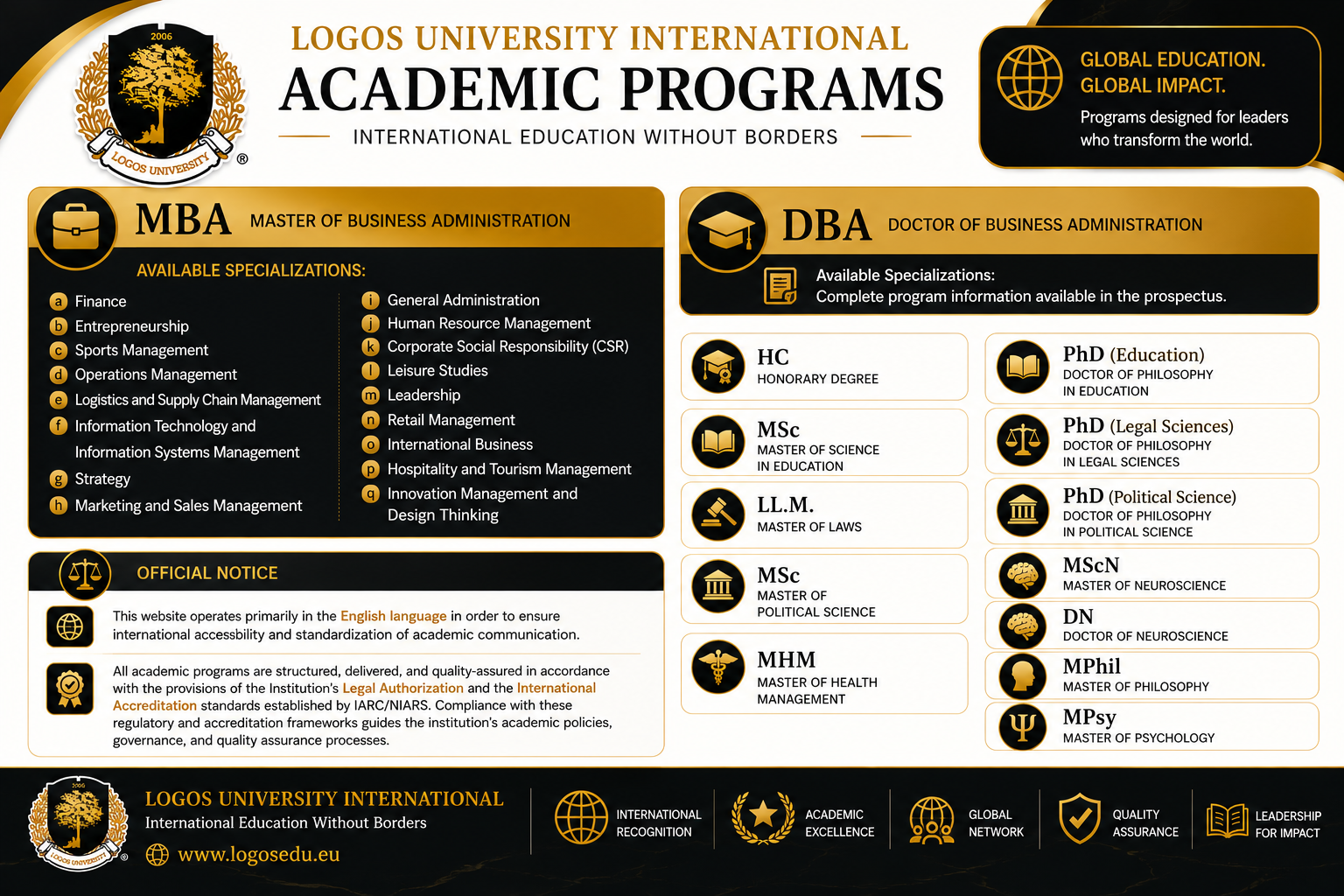
MBA – Master of Business Administration
Available Specializations: a) Finance, b) Entrepreneurship, c) Sports Management, d) Operations Management, e) Logistics and Supply Chain Management, f) Information Technology and Information Systems Management, g) Strategy, h) Marketing and Sales Management, i) General Administration, j) Human Resource Management, k) Corporate Social Responsibility (CSR), l) Leisure Studies, m) Leadership, n) Retail Management, o) International Business, p) Hospitality and Tourism Management, q) Innovation Management and Design Thinking
DBA – Doctor of Business Administration
Available Specializations: Complete program information available in the prospectus.
HC – Honorary Degree
MSc– Master of Science in Education
PhD (Education) – Doctor of Philosophy in Education
LL.M. – Master of Laws
PhD (Legal Sciences) – Doctor of Philosophy in Legal Sciences
MSc – Master of Political Science
PhD (Political Science) – Doctor of Philosophy in Political Science
MHM – Master of Health Management
MScN – Master of Neuroscience
DN – Doctor of Neuroscience
MPhil – Master of Philosophy
MPsy – Master of Psychology
Official Notice
This website operates primarily in the English language in order to ensure international accessibility and standardization of academic communication.
All academic programs are structured, delivered, and quality-assured in accordance with the provisions of the Institution’s Legal Authorization and the International Accreditation standards established by IARC/NIARS. Compliance with these regulatory and accreditation frameworks guides the institution’s academic policies, governance, and quality assurance processes.
Legal Framework and Delimitation of Regulatory Competencies
Logos University International (UniLogos)
Logos University International (UniLogos) is a private higher education institution established under the legal framework provided by the French Education Code for private institutions, through declaration and authorization before the competent academic authority.
Within the French legal system, the public university system constitutes a distinct structure composed of universities and institutions authorized by the State to formally integrate its academic and regulatory organization. Private institutions operating outside this structure conduct their activities under an autonomous regime, without automatic integration into the aforementioned system.
I. Evaluation of Management Programs
The authority responsible for evaluating management programs within the French public university system is the Commission d’Évaluation des Formations et Diplômes de Gestion (CEFDG), a body attached to the French Ministry of Higher Education.
Such authority is limited to institutions that are integrated into or formally linked to the French public university system. As UniLogos operates under an independent private regime, it is not subject to this regulatory procedure.
II. Regulation of the Engineering Degree
The protected title “Diplôme d’Ingénieur” falls under the jurisdiction of the Commission des Titres d’Ingénieur (CTI), a statutory authority established by law to supervise the academic quality of institutions authorized by the State.
UniLogos does not offer programs leading to this regulated title within the French public university system; therefore, the regulatory authority of the CTI does not apply to its institutional activities.
III. Conférence des Grandes Écoles
The Conférence des Grandes Écoles is an associative body bringing together institutions classified as Grandes Écoles, a distinct and selective segment of French higher education structurally connected to the French public university system.
UniLogos does not fall within this institutional category and does not claim membership, recognition, or any formal affiliation with the aforementioned association.
IV. Institutional Positioning Statement
UniLogos operates under administrative authorization duly declared before the Académie de la Rectorat de Paris, in compliance with the legal regime applicable to private institutions.
Its programs are structured under an international higher education perspective and do not integrate into the French public university system, nor are they subject to the legal regime applicable to French public institutions or to professional titles protected by the French State.
With regard to its external quality assurance, the institutional accreditation of Logos University International (UniLogos) has valid and legitimate legal standing at the international level, having been granted by a body formally authorized by the Ministry of Education and Science of the Kyrgyz Republic, a state authority vested with legal competence in educational matters.
The IARC/NIARS agency is authorized by the Ministry of Education and Science of the Kyrgyz Republic and by the National Accreditation Council of that State, acting within delegated competencies under the national quality assurance system.
Additionally, the aforementioned agency is a Full Member of the International Network for Quality Assurance Agencies in Higher Education (INQAAHE), thereby being integrated into an international network of higher education evaluation and accreditation bodies, which further reinforces the internationally recognized character of its quality assurance procedures.
LOGOS UNIVERSITY INTERNATIONAL (UNILOGOS) is an educational entity that offers undergraduate, graduate, research and academic extension courses. We play a crucial role in the training and academic and professional development of students through new educational technologies.
Our overview encompasses many aspects, including our mission, organizational structure, course offerings, research, faculty, infrastructure, and outreach activities. Here are some highlights from our overview as a Higher Education institution:
Mission and Values: Our mission and values are aligned and committed to academic excellence, training qualified professionals, promoting research and innovation, and developing social and ethical skills.
Organizational Structure: The organizational structure can be seen in the item “organization chart”, where we are dedicated to presenting our administrative sectors.
Course Offer: We have a variety of undergraduate and graduate courses in different areas of knowledge, such as: human sciences, exact sciences, social sciences, engineering, health, arts, among others. These courses are offered through UNILOGOS® and in some cases together with other universities through cooperation agreements.
Research and Innovation: We encourage scientific research and innovation. We have consolidated research groups that follow our methodology of: Study, Reflection and Production. Such groups discuss professional and social problems through quality scientific articles, broaden their view of the world and professions, develop critically scientific writing and publish in respected scientific journals with the Web of Science index, Scopus and Qualis Capes (Ministry of Education in Brazil). In addition to the consolidated research structure, we have: virtual research centers, academic mobility with around 12 Universities from different countries for joint research and publication, and programs to encourage scientific and technological production.
Faculty: Our faculty is made up of qualified professors and researchers who give their instructions and guide students. They play a key role in the quality of teaching and the academic development of students. They are up-to-date professionals with publications in strategic areas.
Infrastructure: The institution’s infrastructure includes online classrooms, virtual and physical laboratories (our partners), libraries (open model), sports centers (academic mobility with partners) and other resources that support academic activities and student life.
Extension Activities: We offer extension activities to the community, LOGOS UNIVERSITY INTERNATIONAL (UNILOGOS) maintains access to the Coursera system that provides extension courses through Universities all over the world. In addition, we offer online events in real time (synchronous) with professors and researchers through extension courses, cultural events, continuing education programs, community services and social responsibility projects. We are in our second year of meeting goals and we have won the “social responsibility seal” from ABMES, the Brazilian Association of Higher Education Maintainers. ABMES is the largest organization (association) of sponsors of private higher education institutions in Brazil. It is a very serious body with advisory power before the powers of the republic and the Ministry of Education.
The financial overview of LOGOS UNIVERSITY INTERNATIONAL (UNILOGOS) involves understanding our financial health, revenue sources and resource allocation. Here are some key elements that describe our financial vision:
Income: UNILOGOS® generally obtains income from various sources. This can include student tuition, alumni and private sector donations, government funding, research grants, industry partnerships and other investments. Diversification of income sources is important to ensure financial stability. We still do not have funding from government bodies, but our legal structure allows us to receive such incentives.
Expenses: UNILOGOS® expenses are diversified and cover several areas. This includes the payment of salaries and benefits for professors, researchers and staff, operating costs (such as utilities, maintenance and office supplies), investments in infrastructure and equipment, research and development costs, scholarships and student assistance, among others.
Budget: We operate on an annual budget. The budget is drawn up taking into account expected revenues and planned expenses. It serves as a guide for allocating resources in different areas such as teaching, research, infrastructure and student support services.
Fundraising: We develop our fundraising programs to supplement your revenues. This may involve fundraising campaigns, soliciting donations from alumni and corporate partners, establishing foundations or affiliated institutions, among other efforts to raise additional financial resources beyond the monthly student dues.
Endowment: UNILOGOS® does not yet have an endowment fund in operation, but it has an organized plan for the establishment of such a fund. The fund is made up of donations and long-term investments and aims to generate sustainable income to support academic and institutional activities over time.
Financial Management Policies: We have a financial management project in place to ensure the efficient and responsible use of resources. This may include accountability processes, financial audits, strategic financial planning, cost control and implementing measures to mitigate financial risks. Until the year 2023, UNILOGOS® does not have loans or any type of payment commitment based on bank financing, which brings security in the management of its resources.
Financial Sustainability: Our financial overview also addresses the institution’s financial sustainability. This involves UNILOGOS®’s ability to balance its income and expenses over the long term, ensuring that it has adequate resources to meet academic, research and infrastructure needs, as well as to face unforeseen financial challenges.
A Master’s degree (from Latin magister) is an academic degree awarded by universities or colleges upon completion of a course of study demonstrating mastery or a high-order overview of a specific field of study or area of professional practice.
A master’s degree typically requires previous study at the bachelor’s level, either as a separate degree or as part of an integrated course. Within the area studied, Master’s graduates are expected to possess advanced knowledge of a specialized body of theoretical and applied topics; high-order skills in analysis, critical evaluation, or professional application; and the ability to solve complex problems and think rigorously and independently.
The master’s degree goes back to the origins of European universities, with a papal bull of 1233 decreeing that anyone admitted to the master’s degree at the University of Toulouse should be allowed to teach freely at any other university. The original meaning of master’s was therefore that someone who had been admitted to the master’s degree (degree) (i.e. professor) at one university should be admitted to the same level at other universities. This gradually became formalized as the licentia docendi (license to teach). Originally masters and doctors were not distinguished, but in the fifteenth century it became customary in English universities to refer to professors in the lower faculties (arts and grammar) as masters and those in the higher faculties as physicians. Initially, the Bachelor of Arts (BA) was awarded for studying the trivium and the Master of Arts (MA) for studying the quadrivium.
From the late Middle Ages to the 19th century, the degree standard was therefore to have a Bachelor’s and Master’s degree in the lower faculties and to have a Bachelor’s and Ph.D. in the higher faculties. In the United States, the first master’s degrees (Magister Artium or Master of Arts) were awarded at Harvard University shortly after its founding. In Scotland, the pre-Reformation universities (St Andrews, Glasgow and Aberdeen) developed so that the Scottish MA became their first degree, while at Oxford, Cambridge and Trinity College, Dublin, the MA was awarded to BA graduates from a certain position without further examination from the end of the seventeenth century, its main objective is to confer full membership in the university. At Harvard, regulations from the 1700s required applicants for the MA to pass a public examination, but in 1835 this was awarded the Oxbridge style three years after the BA.
Unilogos® Masters comprise a careful pedagogical project of 36 study credits (1080h), the whole process goes through 4 committees made up of researchers.
Note: Data from the International Standard Classification of Education ( United Nations Statistics Division: UN Classifications Registry, retrieved 30-03-2011)
https://unstats.un.org/unsd/classifications/
Other Reference Sources:
Walter Arthur Donnelly (1941). Degrees Authorized by the University of Michigan. The University of Michigan, an Encyclopedic Survey. University of Michigan. P. 294.
“Master’s Degree Characteristics Statement” (PDF). QAA. September 2015. Retrieved 9 February 2019.
Chambers w. And r, ltd (1862). Edinburgh University. Chambers’s Encyclopaedia • volume III.
“History of Medieval Education, Middle Ages European Learning”. Academic Apparel. Retrieved 8 August 2016.
“Structure of the U.S. Education System: Master’s Degrees”. United States Department of Education. February 2008.
——————–
A Doctorate (from Latin docere, “to teach”) or doctorate (from Latin Doutor, “teacher”) or doctorate, is an academic degree awarded by universities, derived from the ancient formalism licentia docendi (“license to teach”). In most countries, it is a research degree that qualifies the holder to teach at university level, or to work in a specific profession. There are a variety of names for doctorates; the most common is the Doctor of Philosophy (PhD), which is awarded in a variety of fields, from humanities to scientific disciplines.
In the United States and some other countries, there are also some types of vocational, technical or professional courses that are called doctorates. The professional doctorate historically emerged to meet the needs of professionals in a variety of disciplines. However, the need for these degrees can vary greatly across disciplines, making their meaning unclear.
Many universities also award honorary doctorates to individuals deemed worthy of special recognition, either for scholarly work or for other contributions to the university or society.
The term Doctor derives from Latin, which means “teacher” or “instructor”. The doctorate (Latin: doctoratus) appeared in medieval Europe as a license to teach Latin (licentia docendi) at a university. Its roots can be found in the early church where the term Doctor referred to the apostles, church fathers and other Christian authorities who taught and interpreted the Bible.
The right to award a licentia docendi (i.e. the doctorate) was originally reserved for the Catholic church, which required the candidate to pass a test, take an oath of loyalty and pay a fee. The Third Lateran Council of 1179 granted access – at that time largely free – to all eligible candidates. Candidates were tested for aptitude. This right remained a point of contention between church authorities and universities, which were slowly drifting away from the Church. In 1213 the right was granted by the pope to the University of Paris, where it became a universal license to teach (licentia ubiquie docendi). However, while the licentiate continued to enjoy greater prestige than the baccalaureus (baccalaureus), the latter was eventually reduced to an intermediate step towards the master’s (magister) and doctorate, both of which came to be the accepted qualifications in teaching. According to Keith Allan Noble (1994), the first doctorate was awarded in medieval Paris around 1150 by the University of Paris.
Unilogos® Doctorates comprise a careful pedagogical project of 60 study credits (2400h), the entire process goes through 4 committees made up of researchers.
Note: Data from the International Standard Classification of Education ( United Nations Statistics Division: UN Classifications Registry, retrieved 30-03-2011)
https://unstats.un.org/unsd/classifications/
Other Reference Sources:
Verger, J. (1999), “Doctor, doctoratus”, Lexikon des Mittelalters, 3, Stuttgart: J.B. Metzler, pp. 1155–1156
Keith Allan Noble, Changing doctoral degrees: an international perspective, Society for Research into Higher Education, 1994, p. 8.
Doctor of Philosophy. Doctor of Legal Science. Master of Laws by Research. Master of Taxation by Research. Faculty of Law, The University of New South Wales 2009
“American Studies”. Embassy of the United States Brussels. Retrieved 1 October 2016. The degree is open to everyone (including non-Belgians) who has earned the B.A. (in Belgium: licentiaat or license) or an equivalent degree
“Doctoral degree characteristics” (PDF). Quality Assurance Agency. September 2011. p. 12. Retrieved 18 June 2017. The first Doctor of Philosophy (DPhil) in the UK was awarded by the University of Oxford in 1917
Bachelor’s degrees in the United States are typically designed to be completed in four years of full-time study, although some programs (such as engineering or architecture) take five, and some universities and colleges allow ambitious students (often with summer help). school, who are taking too many classes each semester, or who have existing credit on the College Advanced Placement or International Baccalaureate exams) to complete them in less than three years. Some US colleges and universities have a separate academic track known as an “honors” or “academics” program, usually offered to the highest percentile of students (based on GPA), which offers more challenging courses or more seminars or research projects individually targeted. instead of the standard core curriculum. These students receive the same bachelor’s degree as students who complete the standard curriculum, but with cursu honorum notated on the transcript and diploma. Generally, the above Latin honors are separate from the notation for this honors course, but a student on the honors course generally must maintain grades worthy of at least cum laude notation anyway. Thus, a graduate can receive a diploma Artium Baccalaureatum rite or Artium Baccalaureatum summa cum laude in the regular course or Artium Baccalaureatum summa cum laude in cursu honorum in the honors course.
If the student has completed the requirements for an honors degree only in a specific discipline (e.g., English language and literature), the degree is designated accordingly (e.g., B.A. with Honors in English). In this case, the graduate candidate will complete the normal curriculum for all subjects except the selected subject (“English” in the previous example). Requirements in both cases usually call for completion of private honors seminars, independent research at a higher level than normally required (often with greater personal supervision by faculty than usual), and an honors thesis written in the main subject.
Many universities and colleges in the United States award bachelor’s degrees with Latin honors, usually (in ascending order) cum laude (“with honor/commendation”), magna cum laude (“with great honor/commendation”), summa cum laude (“with greatest honor”). honor/praise”), and sometimes seen maxima cum laude (“with utmost honor/praise”).
Requirements for such honors notations usually include minimum grade point averages (GPA), with the highest average required for summa distinction (or maximums, where such distinction is present). For some schools such as Bates College, Carleton College, Colby College, Middlebury College, Guilford College, Franklin College Switzerland and larger universities such as the University of Virginia, Princeton University, Carolina State University of North, University of Massachusetts Amherst. a senior thesis for degrees in the humanities or laboratory research for natural science (and sometimes social science) degrees is also required. Five notable exceptions are Reed College, Massachusetts Institute of Technology, Evergreen State College, Sarah Lawrence College, and Bennington College, which have no dean’s lists, Latino recognitions, or degree programs or disciplines.
Learn more about the Bachelor’s Degree:
“WVU Honors College”. Archived from the original on 4 February 2013. Retrieved 30 December 2012.
Panacci, Adam G. (2014). “Baccalaureate Degrees at Ontario Colleges: Issues and Implications”. The College Quarterly. Retrieved 10 February 2014.
Baccalaureate from the Online Etymology Dictionary (etymonline.com). Retrieved 21 December 2011.
“Bachelor’s + Master’s in Just Three Years”. University of Buckingham. Retrieved 6 August 2016.
“Regulations for Degrees, Diplomas, and Certificates”. Statutes and Regulations. University of Oxford. 16 September 2015. Conversion of BLitt, BPhil, and BSc to MLitt, MPhil, and MSc. Retrieved 6 August 2016.
- University Administration
- Full-Time Faculty
- Emeritus Faculty
- Part Time Faculty
- Adjunct Faculty
Financial Information & 2022-2023 Fee Schedule
Logos University International (UniLogos) reserves the right to change fees and other charges that the Board of Trustees considers to be in accord with sound management.
The course programs have a single price and can be divided into monthly, semester or annual fees.
Each course program has its specific portfolio regulation, you can access our course portfolio with investment, disciplines, methodology and all other information through the “courses” field.
Our billing may occur by bank transfer and credit card. Monthly payments are due on the 10th of each month.In the case of semi-annual payment, maturity will occur in February and July of each year.Different forms of payment and divisions can be combined in a contract when enrolling in the course program.
The fee schedule for the year 2026 is attached.
At LOGOS UNIVERSITY INTERNATIONAL (UNILOGOS), we value and promote an inclusive environment where all people are treated with dignity, respect and equality. Our policy is clear: we do not discriminate on the basis of race, color, religion, national or ethnic origin, sex, gender identity, sexual orientation, age, disability or any other characteristic protected by applicable law.
We are committed to providing a learning, working and living environment free from discrimination, harassment or intimidation. We are committed to fostering diversity, inclusion and equal opportunities for all members of our university community.
This non-discrimination policy applies to all areas of our university, including admissions, enrollment, hiring, promotions, assignment of responsibilities, benefits, access to academic programs and activities, as well as the social environment and all other policies and practices. of the institution.
We encourage our community members to report any incidents of discrimination, harassment or bullying. Our aim is to promptly investigate all allegations, take appropriate action and, where necessary, apply disciplinary sanctions in accordance with established policies and procedures.
In addition, we are committed to providing resources and support for those who have been affected by any form of discrimination. We are committed to providing awareness and training programs to educate our community on the importance of diversity, inclusion and mutual respect.
We reaffirm our commitment to comply with all applicable laws and regulations related to non-discrimination. We will work continuously to promote a safe, inclusive and welcoming environment for all members of our community, valuing diversity of experiences, perspectives and ideas.
Non-discrimination is a core value of our university, and every member of our community plays an important role in fostering a respectful and inclusive environment. Together, we can create a university community that celebrates and values diversity, promoting academic excellence and equal opportunities for all.
If you are a member of our institution and have suffered any type of discrimination, we encourage you to write to our ombudsman, we will act in compliance with all laws, complying with our regulations
Our university’s reimbursement policy was developed to ensure transparency and fairness in dealing with situations involving the return of amounts paid by students. We recognize that unforeseen circumstances may arise, leading to the need to cancel enrollments or request a refund.
The following is a summary of the basics of our refund policy:
Cancellation of Enrollment Before the Start of the Term: Students who cancel their enrollment before the start of the term (within 7 days of signing the course agreement) will be entitled to a full refund of the registration fees and other academic fees paid. However, non-refundable administrative fees may apply as set out in the university’s financial guidelines.
Enrollment Cancellation During the Term: Students who choose to cancel the enrollment during the term may be eligible for a partial refund of fees paid, which refer to advance payment of contract installments. The amount to be refunded will be calculated based on the refund policy established by the university, considering the percentage of the academic term already elapsed and any applicable non-refundable fees.
Refund Policy for Specific Programs: Some specific programs may have different refund policies due to factors such as duration, additional costs and specific requirements. These policies will be clearly communicated to students at the time of enrollment and must be followed in the event of cancellation.
Reimbursement Request Process: Students wishing to request a refund must follow the process established by the university. This typically involves completing the Miscellaneous Request form and providing supporting documentation, if applicable, and awaiting review and processing by the responsible administrative team.
It is important to note that each refund request will be evaluated individually, taking into account established policies and guidelines. Refund policies may be updated from time to time to meet current needs and regulations.
We encourage all students to read and understand the university’s refund policy, available on our institutional website, and to contact finance or administration with any specific questions regarding reimbursement.
The course contract establishes payment rules/norms and course contract termination procedure, be aware of the obligations of the contract establishing rights and duties.
Our aim is to handle each reimbursement request fairly and efficiently, ensuring that students receive proper treatment and amounts due, within the limits established by institutional policy.
To request more information write to: atendimento@unilogosedu.com
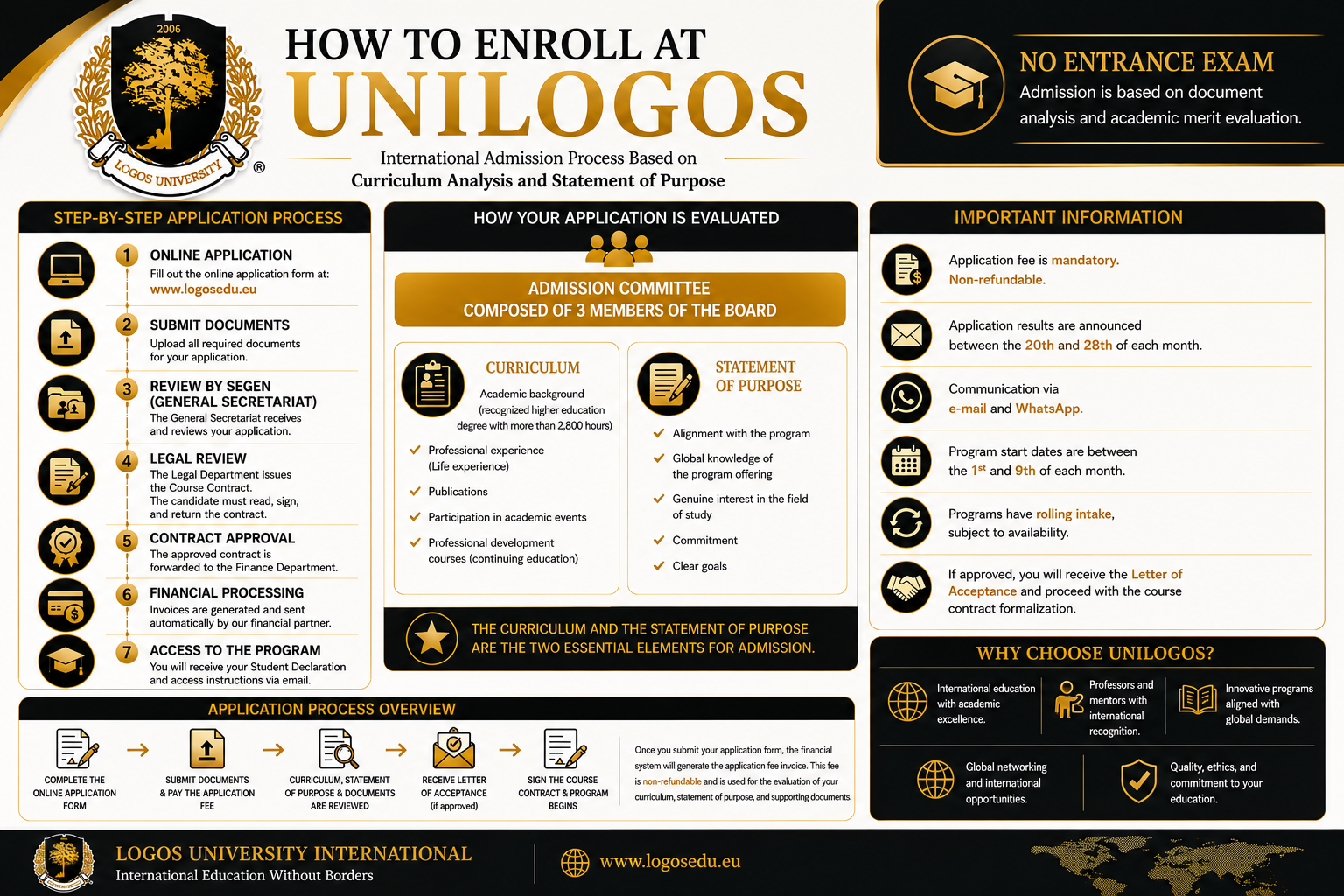
Application Process
Methodology
Learning and Active Teaching Method
The entire Unilogos education system is based on Active Education. Instead of simply presenting problems for new solution proposals, in cases involving subjects, as in PBL, we will base our teaching system on the tripod of globalized active education:
Study, Reflection and Production
“The main objective of education is to create people capable of doing new things and not simply repeating what other generations have done.” — Jean Piaget
Based on Piaget, we can understand the need to form, from now on, a mind focused on research, beyond the passive system of study.
The entire study process has 3 bases – Active Methodology
Students must organize their minds in a learning flow that takes them out of the “passive” teaching process, taking on the role of building their intellectual capital:
The study is considered the act, process of studying; implementation of the intelligence to understand something that is unknown or that if you have little knowledge.
In this methodology the student should read the material indicated without the influence of the thought of a teacher or tutor, so that can successfully go to the 2nd methodological pillar.
It is recommended that the student seek to develop his/her self-taught capacity reading diverse opinions on the topic study.
To do this, you must use any type of research that is at your reach.
Reflection is considered the action or effect of reflecting, of deviating of the original direction. Meditation, thought or detailed analysis about a subject, about yourself or about some problem or feeling.
Reflection is a fundamental attribute and pillar of this process of knowledge acquisition.
Only with reflection we left the sphere of readers for the sphere of scholars.
For each proposed theme, after the proper study, it is necessary to reflect on opinions and thereby form their own form of understand and expose such an understanding.
Production can be considered the way science is known; is the basis for the development and overcoming of intellectual barriers, the victory of a individual by under the dependence of a thought considered to be formed.
As well as its contribution to the science of countries and regions; is the vehicle for the improving the quality of life of its inhabitants.
Production is not only what is transferred to paper, but also what is one builds on itself, as part of the environment in which one lives and of one wants to be.
This pillar is formed by the sum of the two previous pillars.
In The Curatorship of Knowledge you study, but also produces and in a short time becomes noticed by the scientific community. Its production, its Scientific Articles are published together with experienced researchers and known, in this way you enjoy a whole Professional know-how. No activities in university archives, in our methodology the community and society will know you from near. Your career is important!
In some courses we will use Active Education applying the PBL method, in other cases we work with a methodology based on production with a focus on supervised research.
The entire student evolution process may be published in several scientific journals associated with LUI.
Our teaching method has contributed considerably to the scientific community and demonstrates the formation of a truly critical mind capable of transferring its thoughts and knowledge to paper, eternalizing and expanding knowledge.
The vast majority of our courses have research seminars and the presentation of works / lectures focused on exposing criticism and possible solutions to social, humanitarian, scientific and dogmatic problems.
LUI’s masters and doctors are prepared to work with a 360º vision, proposing solutions based on effectiveness and efficiency in their technical-professional processes.
Even having standardized pedagogical projects, our methodology aims to encourage the role of teaching in a multi and interdisciplinary way.
Educational Intelligence is our goal!
Our Methodology and Current Challenges
One of the biggest challenges of a Teaching Academy is to create mechanisms that aim to prevent the mechanization of teaching, transforming it into true learning.
When we talk about learning we are referring to the search for autonomy in the construction of knowledge. It is true that the passive model of teaching with classes no longer brings the expected results for a long time.
Completely adopting the methodologies that are applied in other schools (culture, society and education) is always very complex, since the way of learning differs from people to people.
“With our methodology, the researcher constructs his own subjectivities and conceptions of knowledge with criticality
(Fofonca)
Escola da Ponte (Portugal) is an example of changing this paradigm and an excellent incentive to change our way of seeing methodology.
With teaching based on encouraging autonomy, Escola da Ponte does not divide students into grades or classes. There, they form groups according to their interests to develop projects. Each student goes through three cores as he becomes more autonomous: initiation, consolidation and deepening. While in the first level each student requires more tutoring, in the last one he manages his own activities. The course system is also different. Traditional subjects give way to dimensions: linguistic, logical-mathematical, naturalistic, identity, artistic and personal and social. The aim of the course is to provide Brazilians with the opportunity to better understand how the alternative methodologies of Escola da Ponte work and to encourage that some strategies be adapted to the Brazilian context.
One of the greatest authorities on this subject is called Dr. José Pacheco, he attended one of our seminars. We do not completely apply the “bridge” methodology, but use a hybrid methodology called “knowledge curation”, which is similar to the search for autonomy and the construction of criticality, so necessary for the training of new professionals.
The term Knowledge Curation was mentioned and theorized by Prof. Dr. Eduardo Fofonca.
Prof. Eduardo is a highly regarded post doctor who has been revolutionizing active education and the production of new content.
“In the same way, it is observed that knowledge curation can become an effective way, in the sense of a space-time literacy of digital culture, considering that through it, researchers are allowed to select contributions linked, intrinsically to the teaching practice. It can be said that the relationship between research practice and teaching practice allows us to build increasingly objective knowledge with regard to the readings of the realities that are raised by teaching narratives, as they are articulated with professional practice and teaching training in the context of Basic Education and Higher Education. In this sense, Fofonca and Camas (2019) highlight the development of research on knowledge curation, in the training of researchers working in Basic Education, who end up establishing specific links between educational research that, until then, had academic purposes, contextual objects and, assertively, critics of the educational reality. It should be noted, therefore, that educational scientific research, outlined in the dimensions of knowledge curation, can produce new meanings for what has already been said or worked on in some way, but that sometimes, it was far from reality for there to be the proper meaning. , proper understanding.”
“Aula is a 19th century pedagogical device that no longer makes sense today. The training we have belongs to the instruction paradigm, when we should be guided by the learning paradigm and even the communication paradigm. Instead of classes, we should have workshops, study circles, training projects, gatherings… why not?” (PACHECO)
References:
FOFONCA, E. FISCHER, M. The Curation of Knowledge in EaD: challenges and new perspectives of online research and methodology in teacher education. In. Distance Education and Digital Technologies. Curitiba: Editora Prismas, 2017.
Gossip, E., & Camas, N. P. V. (1). The curatorship of knowledge in immersive environments and the training processes of basic education teachers with innovative methodologies. INTERSABERES MAGAZINE, 14(31), 7-19. https://doi.org/10.22169/ri.v14i31.1596

Consolidated Production - Quality surveys
Article Title: Advertising and Marketing in companies, school libraries and institutional libraries: the underestimation and underutilization of marketing, digital marketing and neuromarketing in libraries
Journal: GeSec – Management and Secretariat Magazine | Brazil | e-ISSN: 2178-9010
Index: Web of Science™ Core Collection, REDIB – Red Iberoamericana de Innovación y Conocimiento Científico, Diadorim – Directório de Políticas Editorials das Revistas Científicas Brasileiras, DOAJ Directory of Open Access Journals, EBSCO Host Publishing, e-Revit@s, SPELL (ANPAD ), Proquest central, Ulrich’s Periodicals Directory, NewJour – Electronic Journals and Newsletter, Academic Journals Database, WZB – Berlin Social Science Center, ZDB: Zeitschriftendatenbank, Genamics Journal Seek, Electronic Journals Library, OCLC WorldCat, Latindex, ResearchBib, Bielefeld Academic Search Engine , EuroPub, Google Scholar.
In addition to all the aforementioned Indexes, the Journal is also evaluated by the Federal Government of Brazil, through the Qualis Capes Quality system, obtaining an A4 grade, among the highest indices of relevance, quality and impact.
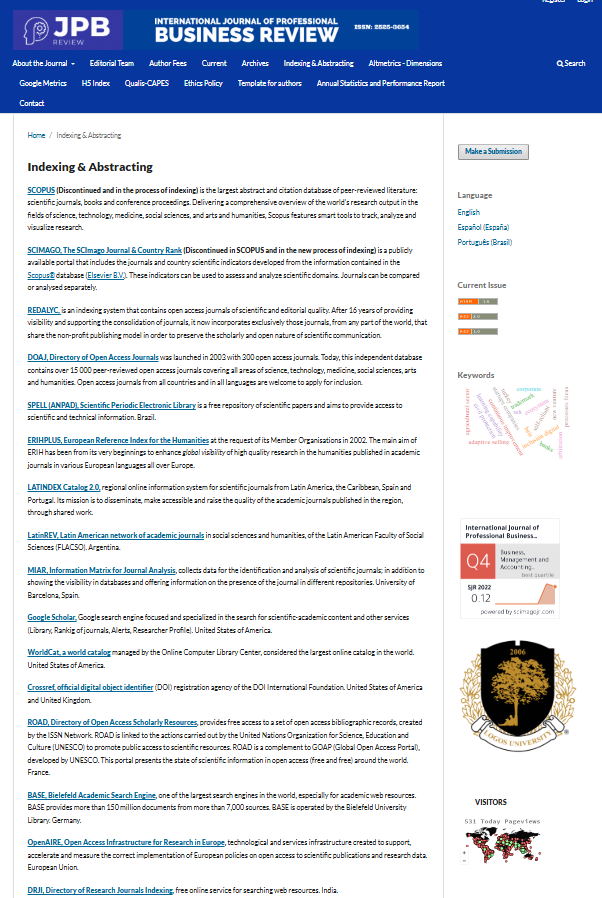
Publications and main quality assessment an excellent impact factor
The International Journal of Professional Business Review (JPB Review) aims to publish original research that contributes to the promotion and dissemination of key themes related to professional business and related fields. The journal is published by Open Access Publications LLC in partnership with Logos University®. Its content seeks to be relevant and thought-provoking for a diverse readership, fostering understanding and dialogue between academia and the business sector on a global level.
Articles submitted to the JPB Review must meet high research standards, offering significant contributions to theory and/or practice in related fields. Reviews may encompass different levels, such as organizations, regions or countries.
The JPB Review challenges its authors to present high-quality research, supported by a solid theoretical basis and conducted with methodological rigor. Demonstrating an innovative conceptual contribution is an essential criterion in the editorial process.
Articles can be submitted in English, Portuguese or Spanish, through the online submission platform (where it is possible to log in and download the template). All submissions undergo a rigorous double-blind peer review process. In addition, all authors are required to have a Contributor ID, such as ORCID or Redalyc ID. ORCID, similar to the Digital Object Identifier (DOI) for articles, is a unique identifier that ensures correct attribution and facilitates the discovery of published works. Registering an active ORCID is essential for manuscript submission and proofreading.
The JPB Review is indexed in several recognized databases and platforms, such as SCIMAGO (The SCImago Journal & Country Rank), REDALYC (Mexico), Directory of Open Access Journals (DOAJ), Latindex, Ebsco Host Publishing, Cengage Gale Learning, PKP Index, Google Scholar and OpenAire. For more information, visit the “Indexing & Abstracting” page.

Logos University® has publications by its researchers and students in over 105 leading scientific journals. The most relevant publications are present in journals with WoS, Scopus and Dimensions. In addition to these important indexes, we have articles published in newspapers rated with the highest index by the Brazilian Ministry of Education.
Our methodology has the mission of preparing researchers and professionals to confront reality, the real world.